A good MSP price starts from what one unit really costs you, tools plus labour, and adds the margin you need. Choose the model your clients understand (per user, per device or tiered), set the price with the formula below, and check every month that what you deliver still matches what you invoice, or the margin you priced will quietly disappear.
01The common MSP pricing models
| Model | How it works | Works well when |
|---|---|---|
| Per device | A monthly price for each workstation, server or network device under management | Device counts are stable and the work follows the devices |
| Per user | A monthly price for each person, covering all of their devices | People use several devices and most support requests come from users |
| Tiered bundles | Good, better and best packages with more services in each tier | You want a simple choice and room to upsell security or backup |
| All-you-can-eat | One flat monthly fee for the whole environment | Scope is very well defined and you know the client's history |
| A la carte | Each service priced separately | Clients buy only specific services such as backup or Microsoft 365 |
Most MSPs combine them: a per-user bundle for support and security, plus per-device or per-licence lines for servers, backup and software.
02A simple pricing formula
For one unit (a user or a device), add up:
- Tool cost: RMM, security, backup and licences you pay for that unit each month.
- Labour cost: average hours spent per unit each month, multiplied by your fully loaded hourly cost (salary, taxes, benefits and overhead).
Then divide by one minus your target margin:
Price per unit = (tool cost + hours × hourly cost) ÷ (1 − target margin)
Example: $18 of tools and 0.6 hours at $55 an hour make a cost of $51. With a 50% target margin the price is $51 ÷ 0.5 = $102 per unit per month.
Profitability in Revtein
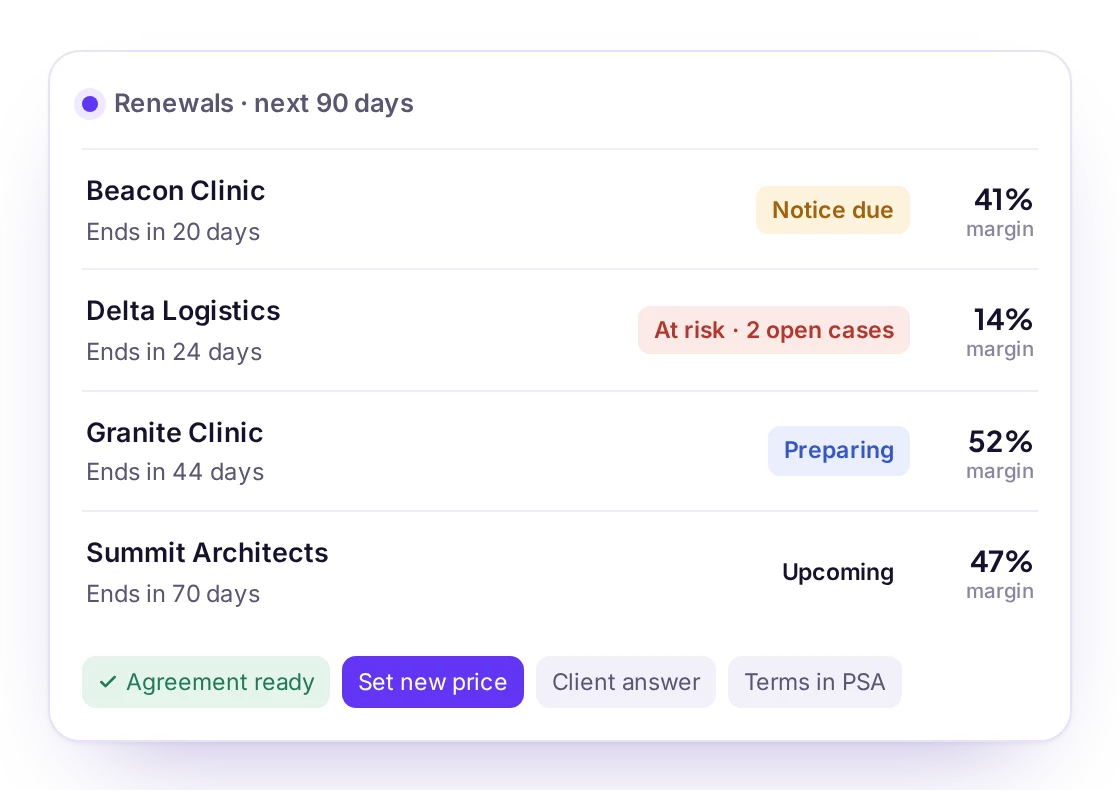
Revtein builds the margin of every agreement from revenue, vendor costs and labor, says when the data is incomplete, and helps you decide the new price before the…
See how it works03Pricing mistakes that cost margin
- Pricing from competitors only. Their costs and labour are not yours. Start from your own numbers, then compare.
- Forgetting labour. Tool costs are easy to see; the hours spent on a client are not, and they usually decide the margin.
- Never repricing. Vendors raise prices during the year. If your contract has no review clause, the increase comes out of your margin.
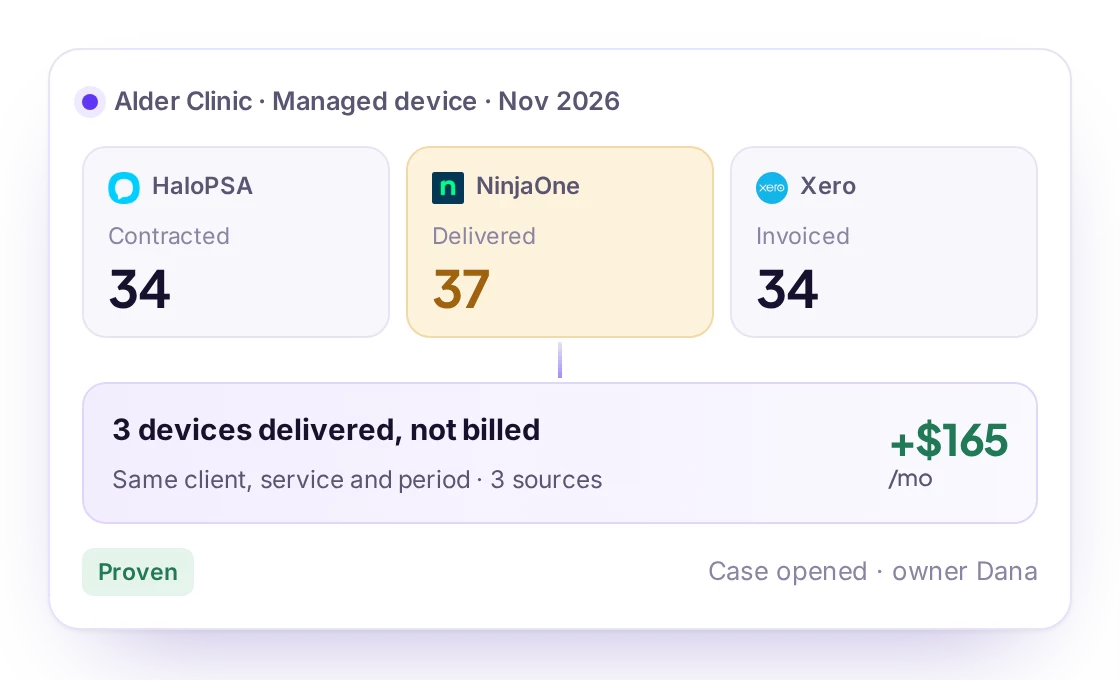
- Billing quantities that drift. A client adds ten users or devices and the invoice still shows the old number. This is the most common way a correct price still loses money.
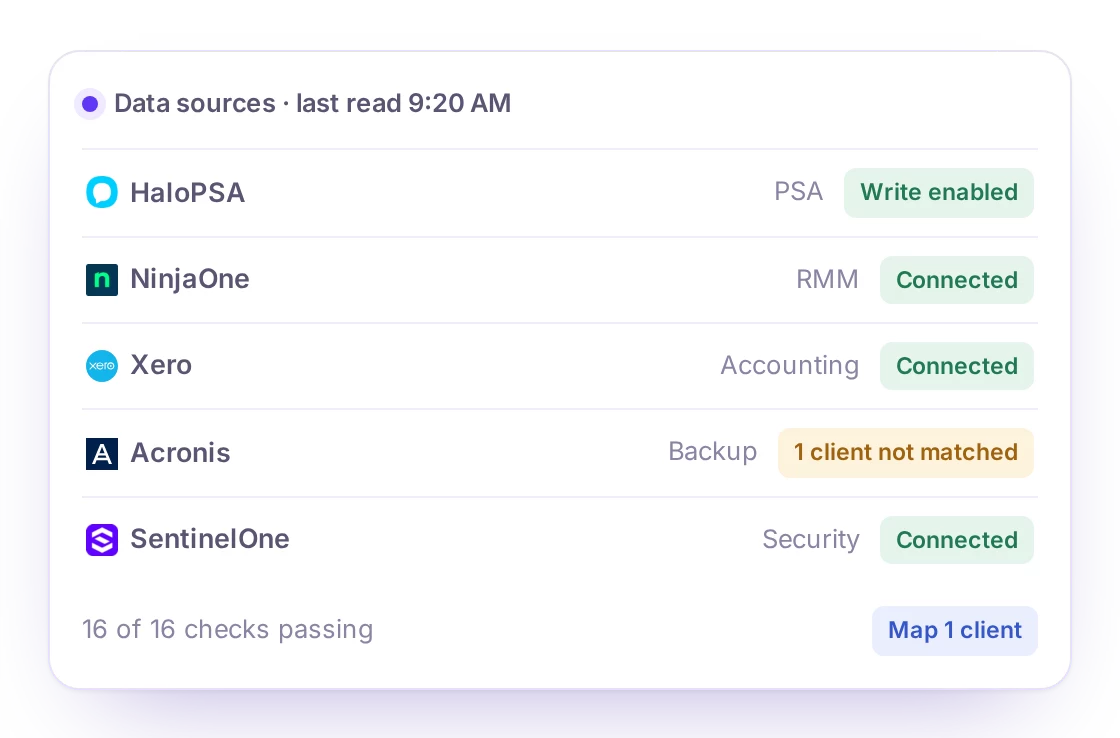
04Keep the margin after you sign
The price is only right while the quantities on the invoice match what you deliver and your costs stay where you assumed. Each month, compare contracted, delivered and invoiced quantities per client, watch vendor price changes, and look at the real margin of each agreement before it renews. This is exactly what Revtein does across your PSA, RMM, backup, security and accounting tools.